![[art]by[odo]](https://artbyodo.net/wordpress/wp-content/uploads/2011/03/cropped-Header.jpg)
 Whether we admit it or not, we’re all attracted to mysteries. We’re attracted to the hidden and forbidden— Pandora’s box, Eden’s apple. Although these myths are usually interpreted as being the explanation for how the troubles of the world were let loose on humanity, some might see their meaning as more inline with the saying, “Curiosity killed the cat.” They are about our insatiable curiosity, our natural, and deeply ingrained, desire to know. In both myths curiosity seems to be condemned; in both, blamed on a woman; in both, the origins of evil and suffering; the fall from grace. These interpretations are only half the story. The other half is about the danger of the secret. If you want someone to know something, hide it, try to keep it secret. It’s about the inevitability of a secret’s exposure. Secrets are hard to keep. The more something is withheld, the more we want it, and if it’s our own secret, the more we want to tell someone. Secrets are dangerous. But these stories are not a warning to avoid opening the box or eating the apple, they’re a warning that secrets, and those who keep them, are dangerous.
The surface of these myths seem to make knowledge, and the search for knowledge, suspect. “Ignorance is bliss.” But humans have a capacity that when exercised makes us a little different from other species on our planet. We can try to escape this urge, but it’s impossible. We are imbued with curiosity, a creative spark, an insatiable desire to explore.
Augustin Fuentes’ book, The Creative Spark, is about much more than curiosity or creativity. They are simply the springboard for him. He finds relationships between our senses, the world, our perceptions of the world, and our assignment of meaning to the world. This is partly illustrated by clearly distinguishing the differences between signs & symbols, and more specifically among iconic signs (a sign that that looks like what it represents), indexical signs (a sign that is correlated with what it represents), and symbolic signs (a sign with no sensory, visual, or temporal relation to what it represents, i.e., abstract), and through this, he defines human divergence from other animals. Symbols are special for a number of reasons. First, their association isn’t obvious. Second, they must be agreed upon by a group, learned and passed on generation to generation. Again, on the surface, this may not seem all that profound, but it’s the right before your eyes obviousness of it that makes it hard to see, or appreciate. Here’s the how & why the book is a good read. Its real significance is hidden below the surface of its words, in the interconnectedness of ideas behind the words, in the illicit implications.
Creativity is built on interconnections of ideas, experiences, and imagination. Whether in the physics lab, the artist’s studio, the mechanic’s garage, or even in figuring out how to make a small paycheck last until the end of the month, creativity is everywhere in the human experience. We are creative every day. But we do not accomplish this miraculous feat on our own.
Writer Maria Popova tells us that creativity is our “ability to tap into our mental pool of resources—knowledge, insight, information, inspiration, and all the fragments populating our minds . . . and to combine them in extraordinary new ways.” Archeologist Ian Hodder agrees, telling us that creativity is the space between the material reality and our imagination where intelligence, adaptability, agency, interpretation, and problem solving all come together, but he also emphasizes that it is a thoroughly social process. Anthropologist Ashley Montagu highlights the fundamental human ability to project our ideas onto the world and transform them into materially resounding reality. This book illustrates the clear connection between these views of creativity and the extraordinary story of human evolution.
Countless individuals’ ability to think creatively is what led us to succeed as a species. At the same time, the initial condition of any creative act is collaboration.
Collaboration as a necessary condition for creation is an interesting notion. We often look at the creative process as an individual artist toiling alone in the studio, the writer locked in a silent room. Yet, all artists, even when working alone, are drawing from a well of previous exposure indispensable for the full process to bloom. There is no isolation for the artist. The concept of the lone genius is completely fallacious. Every artist is intimately connected through social, pedagogical, and historical precedence.
Every poet has her muse, every engineer an architect, every knight a squire, every politician a constituency, but it’s rarely just two or three or four people in the collaboration. More often it’s hundreds or even thousands who collaborate over time and space to produce the most profound creative moments. Dancer-choreographer Twyla Tharp writes, “sometimes we collaborate to jump-start creativity; other times the focus [of collaboration] is simply on getting things done. In each case, people in a good collaboration accomplish more than the group’s most talented members could achieve on their own.” By delving into our past and drawing on the best and most current scientific knowledge, we shall see that creativity is at the very root of how we evolved and why we are the way we are. It’s our ability to move back and forth between the realms of “what is” and “what could be” that has enabled us to reach beyond being a successful species to become an exceptional one. The nature of humans’ creative collaboration is multilayered and varies widely. But our distinctively human capacity for shared intentionality coupled with our imagination is how we became who we are today.
While studying long tail macaques, Augustìn observes notably adaptive behavior. They have an environment rich in resources from the jungle and from the local people who supplement their food supply. With all that abundance, they spend much less time on basic survival work than other monkeys. He notes, “These macaques have a good deal of free time. Time enough for, say, new hobbies.”
At Padangtegal, young and old, male and female, monkeys spend time playing with rocks. They rub them on the ground, in circles, and in puddles of water. They stack them carefully, knock them down, and restack them. They wrap the small rocks in leaves or bits of paper and roll them back and forth across the ground. Every now and then they even use a rock as a tool, to pound a piece of food or to scratch an itch. Aside from being entertaining to watch (for humans) and fun to do (for the macaques), there is no apparent purpose to this behavior, and that is the point. In their leisure time these macaques combine their penchant for manipulating objects and their curiosity (both usually associated with getting food) into a behavior that is quite new. It is not sufficient that they have free time for this kind of play. They must be creative.
“. . . there is no apparent purpose to this behavior, and that is the point.” Ah yes. There is no apparent purpose to anything we do except eat, sleep, and reproduce. Everything else is extraneous. And it’s from this nonessential time spent doing what has “no apparent purpose” that we have philosophy, games, entertainment, science, technology, literature, art, music. These extras don’t come from work. They are not necessary for survival. They are completely superfluous. It’s curious how the things we value the most are unnecessary.
I am immediately skeptical when someone tells me this or that is “important.” Most of the time the person is parroting another’s under-informed opinion, or trying to convince me the expressed opinion is astute when in reality it’s a mind numbingly narrow and simplistic idea. For a book to be important, it’s got to bring to the party a wide range of thoughts and a hairy buffalo barrel full of support to buttress the argument. The Creative Spark spins off in many directions, all focussed on his thesis, all bringing something to light that form conduits that bridge point A to point B, to C, . . , to Z. What at times appears off track soon loops us back to previous concepts, each building upon and boosting the others. The big picture is what makes something important, and Fuentes builds a verbal “Guernica.”
There are many ways to measure whether a cluster within a species is different enough to be labeled a subspecies, and they include both genetic and morphological (body) measurements. This sounds like the same kind of categorization as black, white, Asian, and so on that we see on census forms (and in popular notions of race) today. But it is not.
Apply any measurements of biological race (subspecies) to humans today and you always get only one race. We are all the same subspecies. Neither genetics, nor behavior, nor height, nor body, face, or head shape, nor skin color, nor nose or type of hair, nor any other biological measure divides modern humans into subspecies. If you compare the genetic differences between any two humans from anywhere on the planet, they are much, much smaller than those between any two chimpanzees from Eastern and Western Africa. It is a stunning fact. Humans are spread across the whole world and chimpanzees are found in only a relatively tiny swath across the center of Africa, but humans are far more genetically similar to one another. This pattern is the same for almost all comparisons between humans and any other mammal—we are among the most genetically cohesive and most widespread of any animal on the planet, a combination that is amazingly rare in the animal kingdom. In this measure, as in so many others, we are truly distinctive.
The importance of understanding our genetic sameness is still lost in popular sentiment. Our media aren’t doing much towards helping this either. Few people, other than those immersed in the study, understand the significance how and why humans are so extraordinarily homogenous. We are fooled by external appearances, and unfortunately, hypersensitive to the most subtle differences. This sensitivity to differentiation is critical. Without our ability to discern minute differences, we’d have a hard time recognizing faces and detecting other’s moods. By splitting hairs, though, we make-believe there are bigger differences than actually exist—a natural psychological process, but one that’s also been exploited by our social/cultural constructions—religion and government.
But no other animal in the wild, not even chimpanzees, can look at a rock, understand that inside that rock is another more useful shape, and use other rocks or wood or bone to modify that rock–and share that information with the members of [the] group.
It is this transmission involving learning and sharing, even more than the initial innovation, that is arguably the most creative act.
We go from creative experience to religious experience and back. It’s another unexpected connection that he draws, but one that he argues is incontrovertible. The flush of creativity behind the invention of gods and rituals and rites associated with belief systems which support, even fabricate, our world views is another smack in the face obvious inference. Each line of thought pencils in details from another perspective. The book looks at the creative process from biological, evolutionary, and social angles, and through this multifaceted approach, molds his observations into a ouroboros of concepts.
The fallacy in the “deep roots of warfare” reading of the record of violence is brought into bold relief when we also consider the timeline of the wider range of early human behavior. If you were to plot all of the data about the course of human evolution that we considered in chapters 1 through 6 on a curve over time and then compare that timeline with the timeline of signs of increased violence and of warfare, a much more compelling understanding of the origins and nature of our violence emerges. What stands boldly out is the coincidence of the emergence of more complex societies and sedentism with the rise of coordinated lethal violence and war. Broadly, the rise in economic, political, and social inequality correlates with the rise of war.
Another curveball he throws at us contradicts, to a degree, Steven Pinker’s thesis in his book, The Better Angles of Our Nature.* Pinker hypothesizes that humans today are more peaceful than ever in the history of Homo Sapiens. Fuentes throws a giant wrench into that claim by citing there’s no evidence in the fossil record to indicate prehistoric humans were red-in-tooth-and-claw violent individualists. On a 180° opposite view grounded with archeological evidence, his hypothesis supports Margaret Heffernan’s position that human success is cooperation based.** There’s no doubt, if one looks intently, that cooperation is indeed the number one attribute that has allowed Homo Sapiens Sapiens to dominate the globe. It’s the only means, along with a big prefrontal cortex that powers logic and reason, by which a wimpy, hairless, clawless, fangless little creature, continually trying to defy gravity with a ridiculously upright locomotion, can infest the world with over seven billion copies of itself.
What he does show, instead, is that war and violence is a relatively recent consequence correlated with agriculture, animal husbandry, and large scale social groups which have unintentionally created new problems that we haven’t found positive ways of adaptation.
A key component of the ratcheting up of this complexity in human communities was storage. Once foods can be stored, there need to be systems of maintenance, management, and oversight of the storage. Storage then produces the concept of “ownership” of control over the items being stored and over the locations and structures used for storage. Individuals in most foraging societies have some limited personal ownership—a bow or some pottery or jewelry—but not much, and treat most community goods in a shared manner. Avarice and envy do occur, but most day-to-day interactions over goods in forager societies are more egalitarian and/or shared than in sedentary agriculturalist communities, where ownership of items and property is a key aspect of everyday life.
And we’re off in another direction. But this spray of information spirals around a center to form a web of ideas which collect into a cohesive whole of remarkable integrity. Some writing grabs the reader, some stories grip us, most leave us flat. I can’t say this fits any of those categories. It’s probably not going to hit the best seller list, or have you reading it cover to cover in one sitting. The writing is solidly good, not spectacular. The arch of the story well presented and logical, but not a page-turner. It doesn’t need to be. In fact, a few pages at a time may be more suitable for really absorbing the mounds of information presented. Time is needed to form one’s own mind around these fresh ideas. There’s a lot to digest. Which puts another feather in the book’s cap.
How does a community maintain a sense of cohesion with such stratification and inequality emerging? One mechanism is to develop symbols and rituals that reinforce the group identity. The importance of being in a group and the sense of community identity is likely very old in the human lineage given the core role that cooperation has played in every aspect of our evolution, as we’ve seen in the prior chapters. But when we start to see increasing role differentiation in communities, we also see the signs of the formal development of clans and lineages and of the creation of stories and beliefs that bind them together. The creation of such connections enables larger and larger groups to work together, and to engage in peaceful relationships. And, of course, these same associations and beliefs may help to separate them from others. This is a critical juncture in human history, one where divisions between individuals in communities and between communities themselves start to take on central roles in day-to-day life. It is the institutionalization of these differences within and between communities that is core to the emergence of coordinated violence and warfare.
The idea of exaggerated differentiation and social stratification arises many times. It’s a recurrent theme for me too. Human talent for seeing and understanding fine details sets the ground for making mountains out of mole hills. At some point, we, collectively, are going to have to find a way to balance our knack for high refinement without running our social structure into a dystopia of unrealistic divisions. Over again, I’m brought back to the importance of this idea. For us humans to survival our own hyper-success, we’re going to have to jump into an ocean of humility. Will we drown, or learn to swim?
However, the development of clans, and then greater political entities, provided both the incentive and the justification for one community to attack another without identifying specific individuals as the targets. Humans made the mental shift from individual-on-individual violence to thinking of a whole group or cluster of groups as “the enemy”: We creatively dehumanized other humans.
War as we know it today is not in our genes. It’s a ‘new’ construct ironically emergent from civilization.
As we noted in previous chapters, heightened social and material complexity, inequality, and gender all start showing up hand in hand in this most recent phase of human evolution. Males and females always overlap a lot, but the closer in time we come to the present, the more we see evident differences in their roles in the acquisition and processing of food, in the caretaking of young, in the production of art, in the social hierarchies of societies, and in their sexuality.
As I contemplate the ideas presented, and feebly try to summarize its contents, I realize the fabric of this book is more than can be put into a short review. It trusses together so many facets of human development, psychology, and sociology that I believe one reading may be insufficient to assimilate all its implications.
Academic analyses of art are all well and good, but visceral and personal experiences of art, like the one I had in the cave in Portugal, better convey the power of art in the human story.
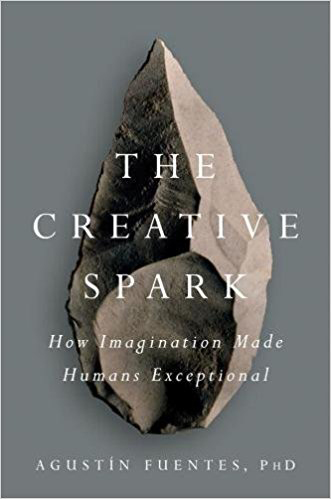 There is no substitute for experiencing art directly. Art does not exist in a vacuum. It does not exist in a vault. Books may present us with facsimiles of the original, or we may find digital representations online. They will never affect an experience. A mural sized painting shrunk to a few centimeters on a piece of paper impregnated with pigments of completely different chemical composition cannot be expected to give us what the artist intended. A shriveled version of a life-size sculpture cannot capture the power of tons of marble lit by the sun. And a short review can’t adequately synthesize a book’s contents, especially one with such broad ranging subjects stitched together to build his argument. But when I step back to look at the entire forest, and I see how these disparate subjects all influence, interrelate, modify, and support each other, I’m at a loss for finding a way to compact it into a clean little package. Some things just have to be experienced first hand.
The Creative Spark, Augustín Fuentes, Penguin Random House, 2017
*see [Really, Really, Really]
**see [Competition Makes the World Go ’round]